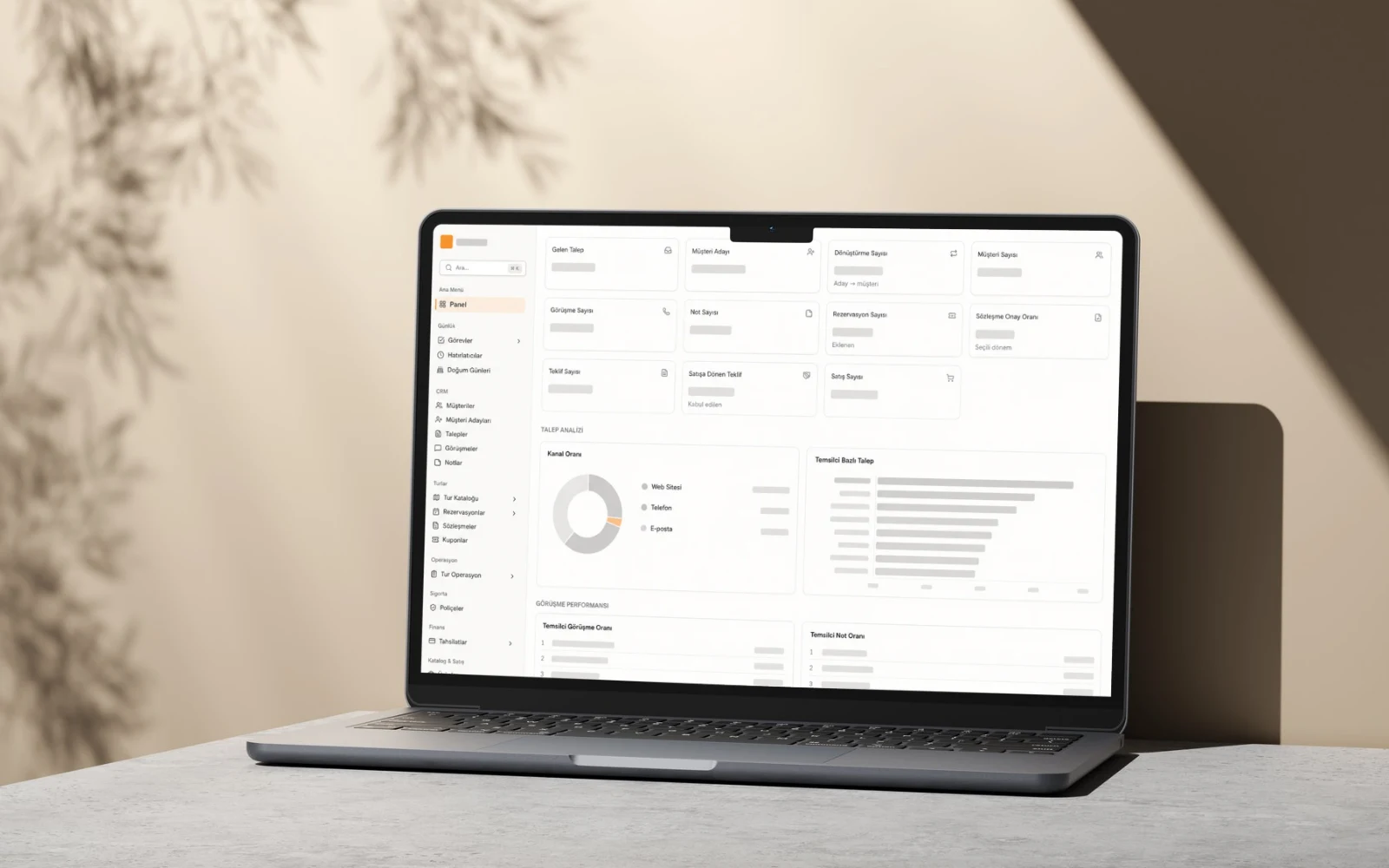

Context
Different departments, one operation.
Antonina Tourism’s sales, reservation, operations and finance processes ran across separate tools and manual workflows. Information was hard to reach, and the same work was repeated between departments.
We observed the process on site and worked with each department separately. We designed and built AGORA as an operations system that runs this work from one center and grows with the company.
What we delivered
- Process analysis & discovery
- UX research & information architecture
- Interface (UI) design
- Software development
- System architecture & data model
- Payment & service integrations
- Launch, training & maintenance
Problem
A growing operation, scattered information.
Customer, sales and reservation data were kept in separate places.
Information moved between sales and operations teams by hand.
Collections and reporting ran independently of operational data.
How it worked before
Solution
Not a single piece of software — a connected way of working.
Sales and customer management
We brought the path from lead to quote to confirmed sale into one structure.
Reservations and operations
We connected tours, rooms, capacity, passengers and operational data so they work together.
Collections and finance
We tied payment links, installments, refunds and financial reporting to sales data.
System map
One data structure, six working areas.
 Built for Antonina Tourism
All six areas work on the same record; a change in one is reflected in the others instantly.
Design and engineering decisions
We analysed how the work actually ran, then built a structure that works better.
01We built the system modularly, following the real operational flow.
02We let each department use the same data in the way its own work requires.
03We simplified repeated and unnecessary steps.
04We built an extensible foundation so new needs can be added.